April 2026 will be one of the most important months for changes to federal rules in Canada. Millions of Canadians from coast to coast will be affected by these new laws and rules.
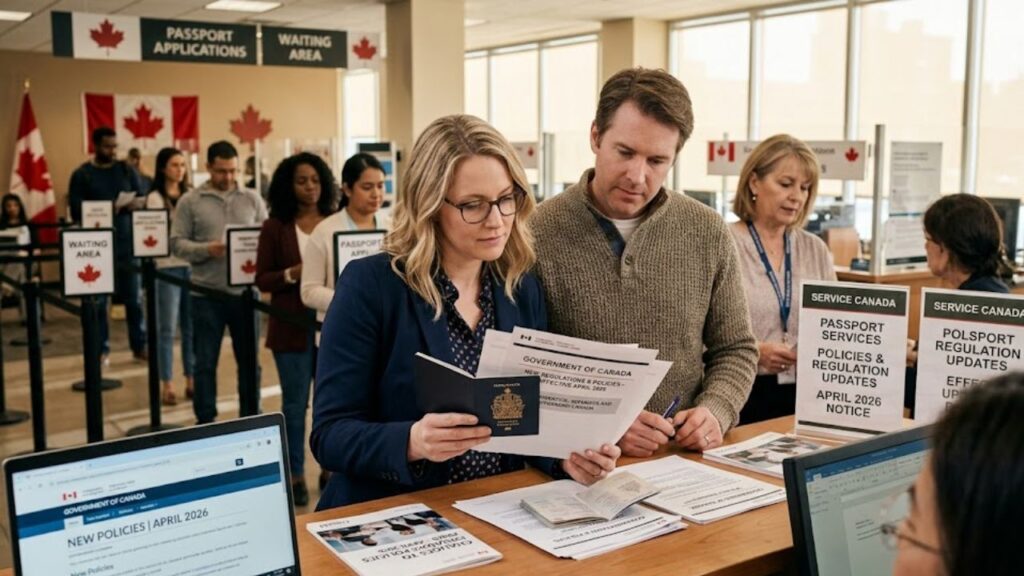
These changes will change how Canadians get basic services and handle their money. For example, they will expand healthcare coverage, add grocery benefits, and raise the minimum wage.
If you’re a patient seeing a nurse practitioner, a worker whose pay has changed because of federal wage changes, or just someone keeping track of new benefits, fees, and tax deadlines, you need to know about these federal changes in order to plan your finances for 2026.

This is all the information you need about the new rules and laws in Canada that will go into effect in April 2026.
Starting on April 1, 2026, the new Canada Health Act Services Policy will be in effect.
On April 1, 2026, a historic change will take place in Canada’s healthcare system. It will greatly broaden public health coverage to include medically necessary services provided by regulated health professionals other than doctors.
The new Canada Health Act Services Policy says that any medically necessary service that nurse practitioners, chemists or midwives can do that is the same as what a doctor does must now be covered by provincial and territorial health care plans.
This change in policy fixes a big hole in Canada’s universal healthcare system that has been there for decades.
Nurse practitioners in Canada now diagnose, refer, and treat patients, which used to be the job of primary care doctors. This is a big change in how health care is delivered.
The federal government has made it clear that patients should not have to pay for medically necessary services provided by these regulated health professionals if the same services would be covered by provincial or territorial health care plans when done by a doctor.
Under the Canada Health Act, starting on April 1, 2026, patients will have to pay extra for these covered services.
This means that every dollar that is wrongfully taken from Canadians will be taken out of provincial and territorial health transfers, dollar for dollar.
The policy makes sure that the same set of hospital and doctor services that were covered by the Canada Health Act in 1984 will still be covered as the health care system changes.
This change is especially important for the estimated six million Canadians who don’t have a family doctor and have to go to other health care providers, like private nurse practitioner clinics that used to charge patients out of pocket.
The policy will go into effect on April 1, 2026, but enforcement and fines for not following it won’t start until April 2027. This gives provinces and territories time to change their health insurance systems.
Starting in December 2028, provinces and territories will be the first to report any charges to patients for these services.
The Canadian Nurses Association has backed Ottawa’s plans, saying that nurse practitioners are a great value for money in the health care system because they can provide many primary care services.
New Canada Groceries and Essentials Benefit Top-Up
The new Canada Groceries and Essentials Benefit will give more than 12 million low- and middle-income Canadians a lot of financial help. A one-time payment will be made in the spring of 2026.
Bill C-19 quickly passed through Parliament, and on February 12, 2026, the Canada Groceries and Essentials Benefit Act received Royal Assent, making this important affordability measure law.
The one-time extra payment will be equal to a 50% increase in the GST Credit’s value for the year 2025-26. It will be sent out as soon as possible in the spring of 2026, but no later than June 2026.
This $3.1 billion investment will go to about 12 million Canadians who already qualify for the GST Credit.
The Canada Groceries and Essentials Benefit is basically the same thing as the GST/HST Credit, but with more money to help Canadians pay for everyday needs as food prices rise.
Family Type: One-Time Top-Up; Total for 2026–27
- For one person, up to $267; for two people, up to $950.
- Couples with no kids can get up to $349 or $1,225.
- Couple with two kids (net income of $40,000): $533 to $1,890
- Single senior with a net income of $25,000 can get up to $267 or $950.
The Canada Groceries and Essentials Benefit will go up by 25% every year for five years, starting in July 2026. This will give people an extra $8.6 billion in support from 2026 to 2030.
People who get the extra payments don’t have to apply for them, but they do have to file their 2024 tax return to get the spring 2026 top-up and their 2026 tax return to get the bigger payments starting in July 2026.
You don’t have to pay back the Canada Groceries and Essentials Benefit, and you don’t have to pay taxes on it.
The government thinks that these steps will make up for grocery price increases that are higher than overall inflation since the pandemic. This will help families who are having trouble paying for food and other necessities.
Starting April 1, 2026, the federal minimum wage will go up.
The Government of Canada has officially announced that the federal minimum wage will go up to $18.15 an hour on April 1, 2026.
On 2026, Employment and Social Development Canada made the official announcement.
This 40-cent rise from the current rate of $17.75 is a 2.3% increase and brings the total increase since the federal minimum wage was set at $17.75 in 2021 to 21%.
The new rate will be shown in the first pay cheque of April for people who work in federally regulated industries.
The federal minimum wage applies to about 1.1 million workers in the private sector that is regulated by the federal government. This is about 6% of the Canadian workforce.
This includes people who work for banks, phone companies, airlines, interprovincial transportation, postal services, and most federal Crown corporations.
The federal minimum wage is based on Canada’s annual average Consumer Price Index (CPI) and changes automatically every April 1 without the need for new laws or political debate.
Based on early CPI data, earlier estimates put the 2026 rate at $18.10. However, because of rounding rules, the final rate was 5 cents higher.
The federal minimum wage always rounds up to the next $0.05, so $18.12 became $18.15 instead of $18.10.
The federal minimum wage has gone up by $3.15 per hour over the past five years. This means that a full-time minimum wage worker in a federally regulated industry now makes $6,552 more per year than they did in 2021.
If a provincial or territorial minimum wage is higher than the federal minimum wage, federally regulated employers must pay their employees the higher of the two.
Right now, only Nunavut ($19.75) and Yukon (expected to be $18.37 or more after their April rise) are above the federal rate.
Patty Hajdu, the Minister of Jobs and Families, said that raising the minimum wage on a regular basis “protects the wage floor workers rely on and strengthens the standard for fair pay.”
Starting April 1, 2026, new rates for beer and alcohol excise duty will be in effect.
Every April 1, the federal excise duty on beer, spirits, and wine goes up or down based on changes to the Consumer Price Index.
The rise will be about two percent starting on April 1, 2026. This is because the government limited the inflation adjustment through Bill C-69, Budget Implementation Act, 2024.
The duty on regular-strength beer with more than 2.5 percent alcohol will go up to $37.69 per hectolitre, from $36.95.
The first 75,000 hectolitres made by a domestic brewery each year will still pay lower excise rates.

As of April 1, 2026, the two-year temporary relief that cut excise duty rates by half on the first 15,000 hectolitres brewed in Canada has come to an end.
The rates for spirits and wine excise duty are also changing for duty that is due on or after April 1, 2026.
If a beer, spirit, or wine doesn’t have more than 0.5% absolute ethyl alcohol by volume, it doesn’t have to pay excise duty.
The Canadian Craft Brewers Association and other industry groups have said that these changes will make things more expensive for breweries, including ingredients and labour.
Because of this, beer prices may go up a little, but the capped two-percent increase makes the effect less severe than if the full CPI adjustment had been made.
According to industry estimates, the two percent increase will cost Canadian taxpayers about $41 million in total in 2026–27.
April is the last day to file your taxes.
April 30, 2026, is the last day to file your taxes and pay them for the 2026 tax year.
If you don’t file on time, you could have to pay interest and late fees, and your benefit and credit payments could be delayed.
The Canada Groceries and Essentials Benefit (formerly the GST/HST Credit), the Canada Child Benefit (CCB), and the Old Age Security (OAS) benefits are all part of this.
To get the higher Canada Groceries and Essentials Benefit payments that start in July 2026, you must file your 2026 tax return.
Self-employed people who use most of their business expenses to invest in a tax shelter must also file by April 30, 2026.
Other people who work for themselves have until June 15, 2026 to file their tax returns. However, they must still pay any taxes they owe by April 30 to avoid interest charges.
As of July 1, 2026, the Carney government cut the lowest federal income tax rate from 15% to 14%.
This means that the lower tax rate will be in effect for the whole year for the first time in 2026, which will save almost 22 million Canadians up to $420 per person.
The CRA will start automatically filing taxes for a first group of lower-income Canadians in 2026. This is meant to cut down on missed benefits that happen when people don’t file.
The rollout is meant to grow over time, with federal communications saying that by the 2028 tax year, millions more will be included.
New Canadian Federal Procurement Policies
The Buy Canadian Policy from the Government of Canada, which started in December 2026, will be fully in place by spring 2026. It will include more steps to make Canada’s economy stronger.
The Policy on Prioritising Canadian Suppliers and Canadian Content in Strategic Federal Procurements will apply to contracts worth $5 million or more by June 15, 2026. This is a drop from the current threshold of $25 million.
This policy says that Canadian suppliers and Canadian content should be given priority in federal procurement processes by giving Canadian suppliers an edge in the evaluation process.
Canadian suppliers will have their financial proposals cut by 10% so that they can be evaluated.
Entities that want to buy something will also have to either give 25% of the total evaluation score to a Canadian value-added requirement criterion or give Canadian content a 25% credit.
By spring 2026, the Policy on Reciprocal Procurement will also be fully in place. This means that Canadian suppliers, goods, and services, or those from trusted trading partners with reciprocal procurement market access, will only get non-defense federal contracts.
This policy says that a supplier’s eligibility depends on where the goods and services come from, not where the bidder’s main office is.
In the spring of 2026, a new Small and Medium Business Procurement Program will start up with the help of Innovation, Science, and Economic Development Canada.
This program will make special paths for small and medium-sized businesses (SMBs), give them one-on-one help to help them understand the federal system, and make sure they can compete well for federal contracts.
Budget 2026 set aside almost $186 million in new money to fully carry out the Buy Canadian Policy. This includes $79.9 million over five years to help start the Small and Medium Business Procurement Program.
The Buy Canadian Policy will apply to spending on infrastructure and other federal funding sources. This means that up to $70 billion more in public investment will go toward Canadian-made goods and services.
There are new NSF fee limits in place.
Even though this isn’t a change that happened in April, it’s important to remember that new federal rules went into effect on , 2026, limiting non-sufficient funds (NSF) fees to $10.
All federally regulated banks and credit unions, including Canada’s Big Six banks, will be affected by this big change.
Before, Canada’s big banks charged between $45 and $48 for each NSF transaction. This meant that if your account was even $1 short when a payment tried to go through, you could be charged $48.
According to the new rules, people can’t be charged more than $10 in NSF fees if they don’t have enough money in their personal deposit account to make a payment.
There are also important extra protections for consumers in the rules.
- A person will not have to pay an NSF fee more than once in two business days for the same personal deposit account.
- If someone has less than $10 in overdraft on their personal deposit account, they won’t have to pay NSF fees.
The Financial Consumer Agency of Canada (FCAC) will make sure that businesses follow the new rules about NSF fees.
The Department of Finance says that about 34% of Canadians pay at least one NSF fee each year. This means that there will be about 15.8 million NSF transactions in 2023 alone.
The federal government says that this change will save Canadians about $619 million in the first year and more than $4.1 billion over ten years.
François-Philippe Champagne, the finance minister, said, “Even if someone is only $5 short when paying a bill or covering a cheque, they could be charged a non-sufficient funds fee of up to $50.”
You could use that money for groceries, medicine, or other daily needs.
Important: NSF fees have a limit, but this doesn’t mean that merchants can’t charge you late payment fees when your payment bounces.
The rules only apply to personal and joint accounts at federally regulated banks and credit unions, not to business or corporate accounts.
Fourteen federally regulated banks, including Canada’s six largest banks, have also signed on to a new Commitment on Low-Cost and No-Cost Accounts. Since 2026, Canadians have been able to open modernised no-cost and low-cost accounts that cost no more than $4 per month.
Important Dates for Changes in Canada in April 2026
| Date | Change in the Federal Government |
|---|---|
| April 12, 2026 | The NSF fee limits (maximum of $10) go into effect. |
| April 1, 2026 | The Canada Health Act Services Policy goes into effect. |
| April 1, 2026 | The federal minimum wage goes up to $18.15 an hour. |
| April 1, 2026 | Beer, spirits, and wine excise duty rates go up about 2%. |
| April 30, 2026 | The last day to file taxes for the 2026 tax year. |
| Spring 2026 | Canada Groceries and Essentials Benefit one-time top-up (by June) |
| Spring 2026 | Buy Canadian policy fully in place with SMB program |