A tax-free savings account (TFSA) is a type of registered account that lets you save or invest money without having to pay taxes on any interest, gains, or dividends you make in the account.
Investors have liked TFSAs since the federal government made them available in 2009. According to the most recent data from the Canada Revenue Agency (CRA), which is based on contributions made in 2023, more than 18.4 million Canadians have TFSAs.
What is an account for saving money without paying taxes?
A TFSA is an account that the government keeps track of. You can use it to save a certain amount of money each year without having to pay taxes on any interest or other earnings. You need to be a Canadian citizen, at least 18 years old, and have a valid Social Insurance Number (SIN) to open a TFSA.
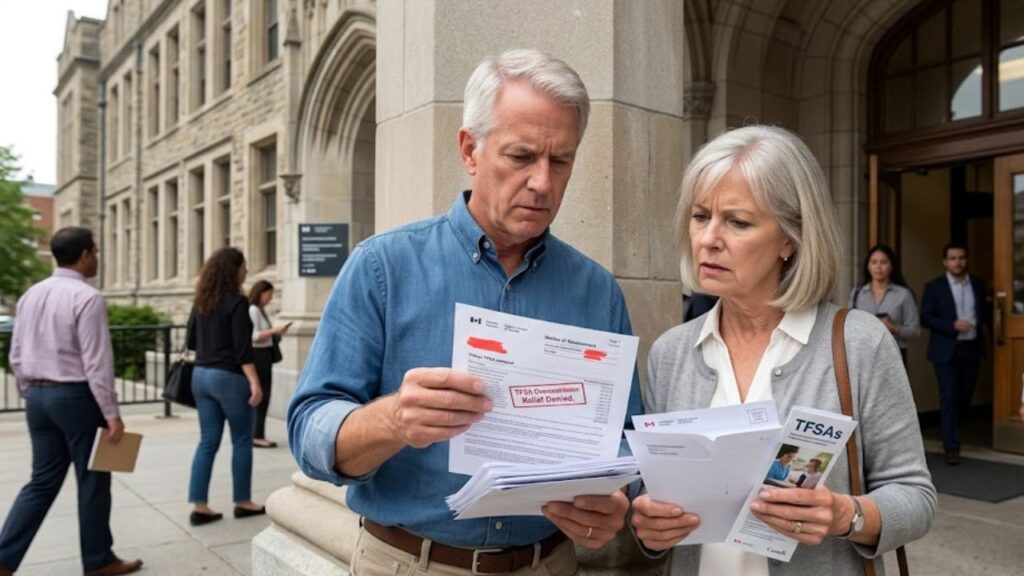
 CRA Refuses TFSA Tax Cancellation: Overcontribution Penalties Remain For Affected Canadians
TFSAs are like other registered accounts, like registered retirement savings plans (RRSPs). The main difference between a TFSA and an RRSP is that you can’t deduct the money you put into a TFSA from your taxes, but you can deduct the money you put into an RRSP.
When you take money out of your TFSA, the opposite is true: you won’t have to pay taxes on the money you get from your RRSP.
What does a TFSA do?
You can use a TFSA to save money for things you need or want in the future. Some people use a TFSA to save money for short-term goals, like an emergency fund or a down payment. Some people use a TFSA to save for retirement or invest in the stock market, which are both long-term financial goals.
You can use TFSAs as part of a tax-advantaged investment plan that lets you invest in a way that fits with your goals’ timeline and risk level. Say you’re a careful investor who is saving up for a down payment on a house in five years. In a market with low interest rates, you might want to choose a TFSA GIC to grow your savings tax-free without putting your principal at risk.
How to find out how much you can put into your TFSA
There are limits on how much you can put into a TFSA each year. Make sure you know how much you can put into a TFSA before you start investing in one. The maximum amount you can put into a TFSA in 2026 is $7,000 annual limit.
But the TFSA contribution room grows over time. If you could have contributed in the past but didn’t, the unused room from those years is added to the room for the current year. This is the total contribution amount you have contributed to your TFSA so far. As of 2026, the total amount that Canadian residents who were at least 18 years old in 2009 can put into their TFSA is $109,000 total limit.
If you’ve put money into or taken money out of your TFSA in the past, you’ll need to add those amounts to your calculation of how much you can put into a TFSA.
You can see how much room you have in your TFSA by going to your CRA My Account. But your CRA My Account may not show the right amount of contribution room if you’ve made contributions or withdrawals since the beginning of the year, because banks usually only report your contributions once a year.
You can use the following formula to figure out how much you can actually contribute this year:
Current year’s contribution limit + unused contribution room from previous years + withdrawals made in previous years – any contributions already made this year = current available TFSA room
NerdWallet’s TFSA contribution room calculator can also help you figure out how much TFSA contribution room you have so far.How taking money out of your TFSA affects your contribution room
If you take money out of your TFSA, the amount you take out is added back to your contribution room on January 1 next year.
For instance, let’s say you’ve been putting the most money into your TFSA every year since 2009. You put in $7,000 in August 2025 and took out $10,000 in November 2025. You could give $17,000 on January 1, 2026. This would be $7,000 for 2026 and $10,000 to make up for your withdrawal.
You could have put that $10,000 back into your TFSA right away if you hadn’t contributed as much over the years and had enough room to do so.
Some of the investments you have in your TFSA, like term deposits or GICs with a maturity date, may not let you take money out. You can’t put more money into your account because of investment losses impact.
Is a TFSA transfer the same as a withdrawal?
As long as you ask your new bank to start the transfer, moving your TFSA from one bank to another doesn’t count as a withdrawal. But if you take out your money and then try to put it in the new bank, it will count as a withdrawal. You need to make sure you don’t hit contribution limits penalties or over-contribution penalties.
Make sure to ask your new bank if they will pay for the transfer and if they charge transfer fees.
How to start a TFSA
You should pick a bank, insurance company, or investment firm that meets your needs the best before you open a TFSA.
To get a TFSA, you need to:
- Be a Canadian resident (if you’re not a resident, you have to pay 1% tax on the contribution every month it stays in your TFSA).
- Get a valid SIN.
- Be at least 18 years old or the legal age in your province.
You can open a TFSA and put in the full amount of the yearly contribution limit on the day you turn 18. If you turn 18 on November 1, 2025, for example, you can open a TFSA and put in the full $7,000 annual limit on that day.
Is a TFSA a good idea?
If you want to make the most of your tax-free earnings growth, a tax-free savings account might be a good choice. Here are some reasons why TFSAs are a great addition to your investment strategy:

- Earnings that aren’t taxed. You don’t have to pay income tax on any money you take out of the account, like interest or investment gains.
- Withdrawals are easy. A tax-free savings account is a simple way to save for emergencies or planned purchases without having to pay taxes on the interest you earn on that money. Also, if you take money out, you get your contribution room back the next year.
- Every year new contribution room. Everyone gets extra TFSA contribution room every year, no matter how much money they make. That room will still be there for future contributions, even if they can’t use it right away.
- Flexibility in investments. A TFSA lets you save and invest in a variety of ways, such as bonds, stocks, and ETFs. This can help you reach your short- and long-term goals.
|
|
|||
|---|---|---|---|
|
Eligibility |
Canadian residents at least 18 years of age with a valid Social Insurance Number (SIN). |
Anyone who is less than 71 years old, earns income and pays taxes. |
Anyone with a valid Social Insurance Number (SIN). |
|
Contribution limit |
$7,000 for 2026. |
18% of your income, up to $32,490 for 2025 and $33,810 for 2026. |
No maximum deposit limits but minimum balance requirements may apply. |
|
Contributions tax-deductible? |
No. |
Yes. |
No. |
|
Tax-free withdrawals? |
Yes. |
No. |
No. |
TFSA alternatives to think about: TFSAs and RRSPs are government-approved accounts that help you save and invest. Both RRSPs and TFSAs offer tax benefits, but the way these benefits work is what sets them apart.
Another option is a non-registered savings account, which holds money and earns interest but doesn’t have any tax benefits.
You can figure out how to best use each of these accounts by knowing what makes them different.